The modern AI boom runs on graphics processing units. GPUs were designed in the 1990s to render video game pixels; today they train large language models consuming megawatts of power in purpose-built data centres. The hardware is extraordinary. It is also, in a fundamental sense, deeply wrong for the job.
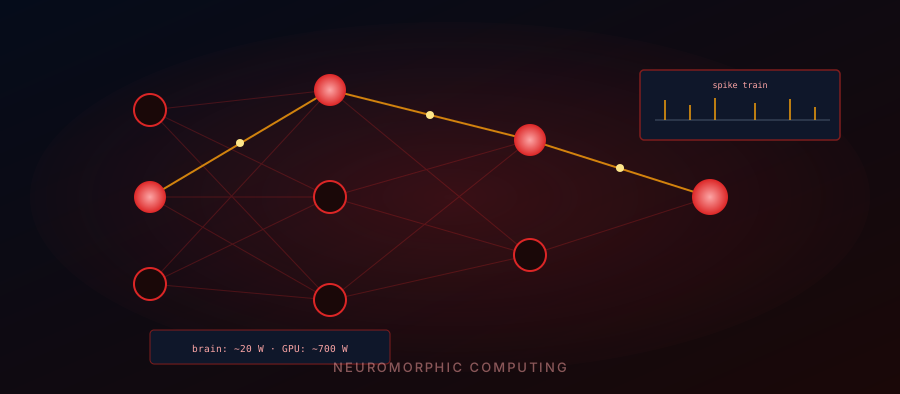
The human brain performs the cognitive feats we are trying to replicate — vision, language, spatial reasoning — on approximately twenty watts. A smartphone battery could theoretically power it for hours. An NVIDIA H100 GPU, running a fraction of a comparable workload, draws 700 watts and costs forty thousand dollars. The gap between biological and silicon intelligence, measured in energy efficiency, spans roughly six orders of magnitude.
Neuromorphic computing is the field trying to close that gap — not by making GPUs more efficient, but by abandoning the architectural assumptions that make them inefficient in the first place.
How Brains Actually Compute
Conventional artificial neural networks are a loose mathematical abstraction of biology. A neuron is modelled as a weighted sum followed by a nonlinear activation function, computed on every clock cycle for every neuron, regardless of whether anything meaningful is happening in the network. The computation is dense, synchronous, and power-hungry by design.
Biological neurons do not work this way. A real neuron sits idle most of the time, accumulating small electrical signals. When those signals cross a threshold, it fires a brief, discrete pulse — a spike — and then resets. This spike propagates through the network and triggers other neurons to integrate and potentially fire in turn. Between spikes, the neuron consumes almost no energy. Processing is event-driven: computation happens only when information arrives, not on a fixed clock.
Spiking neural networks (SNNs), which model this biological behaviour, are the computational foundation of neuromorphic hardware. In an SNN, time is an explicit dimension of the representation — the precise timing of a spike carries information, not just whether a neuron is activated. This makes SNNs naturally suited to temporal and sensory data: audio, video, touch, lidar point clouds.
The Von Neumann Bottleneck
Modern processors — GPUs, CPUs, and the TPUs running cloud AI inference — share a fundamental architectural constraint: they separate memory from computation. Every neural network operation requires data to travel from memory to processor and back. At the scale of modern AI models, this memory-compute shuttle is the dominant source of energy consumption and latency, a constraint known as the Von Neumann bottleneck.
Neuromorphic chips dissolve this bottleneck by co-locating memory and computation. In Intel’s Loihi architecture, synaptic weights are stored directly at the computational core that uses them. There is no bus to traverse, no off-chip DRAM to fetch from. Memory is the processor.
This architectural choice has profound consequences. Operations that consume hundreds of joules on a GPU — running inference on a continuous sensor stream, for example — can cost microjoules on a neuromorphic chip, because computation only occurs in the precise cores activated by incoming spike events, and memory accesses are entirely local.
The Hardware Landscape
Intel’s Loihi 2 is the most accessible research platform, available through Intel’s Neuromorphic Research Community. Its 1 million programmable neurons and 128 neuro-cores can solve optimisation problems and run sensory inference at efficiencies impossible on conventional hardware.
IBM’s NorthPole takes a different approach: rather than implementing biological spiking exactly, it adopts the architectural insight — co-located memory and compute — and applies it to conventional deep learning inference. In a 2023 paper published in Science, IBM demonstrated NorthPole running ResNet-50 image classification at 25 times the energy efficiency of a leading GPU, with no off-chip memory accesses at all.
European research has produced BrainScaleS (Heidelberg University) and SpiNNaker (University of Manchester), both focused on neuroscience simulation at biological timescales. These platforms can model millions of neurons in real time — capabilities far beyond what classical simulation software can achieve — enabling neuroscientists to test computational theories of brain function directly in hardware.
Where Neuromorphic Computing Excels Today
Neuromorphic hardware is not a general-purpose replacement for GPUs. It is a specialist substrate that excels in specific conditions.
Real-time sensory processing is the clearest advantage. Event cameras — silicon retinas that output a stream of pixel-level brightness change events rather than full frames — pair naturally with neuromorphic processors. The camera produces spikes; the chip processes spikes; the combined system can track fast-moving objects at microsecond latency with milliwatt power consumption. For robotics, autonomous vehicles, and drone navigation, this matters enormously.
Edge AI and always-on inference is another stronghold. A wearable health monitor that continuously analyses ECG waveforms for arrhythmia cannot drain a battery running a GPU. Neuromorphic chips running SNN inference can sustain continuous monitoring for weeks on a coin cell.
Optimisation and constraint satisfaction represent a less obvious but commercially significant application. Loihi 2 has demonstrated competitive performance on graph colouring, travelling salesman instances, and constraint satisfaction problems — solving classes of NP-hard problems more efficiently than classical solvers for certain problem sizes.
The Programming Challenge
Neuromorphic hardware’s biggest obstacle is not physics — it is software. Decades of deep learning progress have produced rich ecosystems: PyTorch, JAX, TensorFlow, CUDA. Training a spiking neural network remains significantly harder. The discrete, non-differentiable nature of spikes breaks the backpropagation algorithm that trains conventional networks.
The research community is addressing this through surrogate gradient methods — replacing the non-differentiable spike with a smooth approximation during the backward pass — and through conversion techniques that map trained conventional networks into equivalent spiking representations. Frameworks including Intel’s Lava, SpiNNaker’s PyNN, and third-party libraries like SpikingJelly are gradually building the tooling infrastructure that hardware alone cannot provide.
The deployment gap remains real: a research team that trains an SNN for edge audio classification cannot today ship it with the same ease as a TensorFlow model deploying to a Raspberry Pi. Closing this gap is the dominant engineering challenge for the field.
Convergence on the Horizon
Neuromorphic computing and quantum computing are often discussed separately, but the most interesting long-term possibility is their convergence. Quantum processors are extraordinarily efficient at sampling from complex probability distributions — exactly the kind of computation that underlies Bayesian inference and generative modelling. Neuromorphic chips are extraordinarily efficient at real-time event-driven processing. A hybrid system where quantum hardware handles probabilistic reasoning and neuromorphic hardware handles sensory-motor integration could approximate biological cognition far more closely than either architecture alone.
That convergence is speculative and years away. What is not speculative is the near-term trajectory: as edge AI workloads multiply, as energy constraints tighten, and as the economics of running hundred-watt inference chips at scale become harder to justify, the architectural assumptions of the GPU era will face mounting pressure. Neuromorphic chips represent the most mature alternative on the table — not a replacement for what exists, but a new tool for problems the existing stack was never designed to solve.
Sources & Further Reading
- Loihi: A Neuromorphic Manycore Processor with On-Chip Learning. IEEE Micro 38(1) (2018)
- Neuromorphic Electronic Systems. Proceedings of the IEEE 78(10) (1990)
- Towards Spike-Based Machine Intelligence with Neuromorphic Computing. Nature 575, 607 (2019)
Discussion