Tag
#AI integrations
3 articles
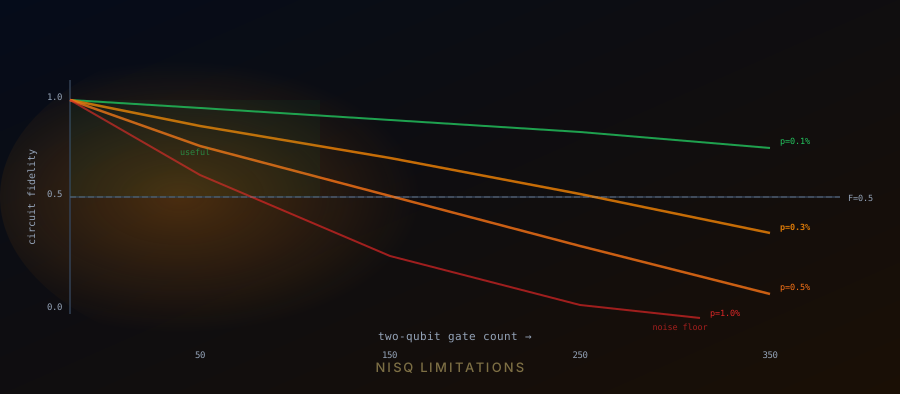
- The Honest State of NISQ: What Noisy Intermediate-Scale Quantum Computers Can and Cannot Do
John Preskill coined 'NISQ' in 2018 to describe the quantum processors of the near-term era — 50 to 1000 noisy qubits, too small for error correction, too large to fully simulate classically. Seven years later, the honest accounting is clearer: NISQ has produced important scientific insights and genuine hardware progress, but no quantum advantage on a practically useful problem. Here is exactly why, and what the path forward looks like.
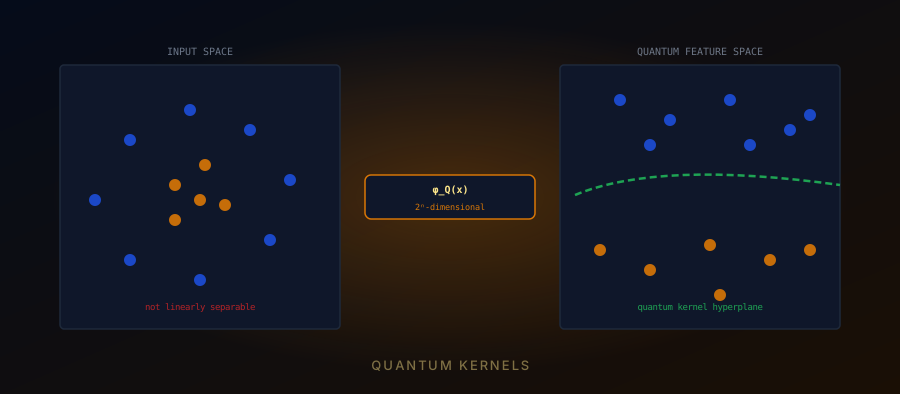
- Quantum Kernels and QSVMs: Can Quantum Feature Spaces Give Machine Learning an Edge?
Support vector machines classify data by finding a separating hyperplane in a high-dimensional feature space, using the kernel trick to avoid computing the feature map explicitly. Quantum computers can evaluate inner products in exponentially large Hilbert spaces — making quantum kernels a natural candidate for quantum advantage in machine learning. Here is how quantum kernel SVMs work, what has been proved about their advantage, and where the honest limits currently lie.
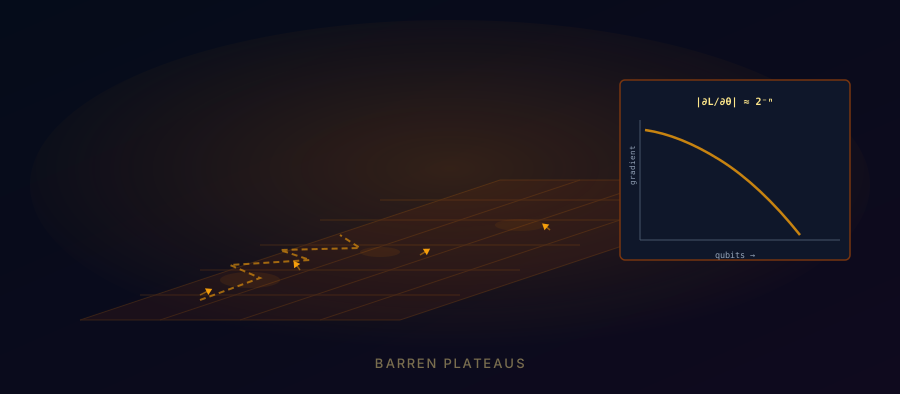
- Vanishing Gradients at Quantum Scale: The Barren Plateau Problem in Quantum ML
Parametrised quantum circuits are the foundation of quantum machine learning — but a fundamental obstacle called the barren plateau causes gradients to vanish exponentially as circuits grow. Here is what causes it, why it almost derailed the field, and the strategies now being used to navigate around it.